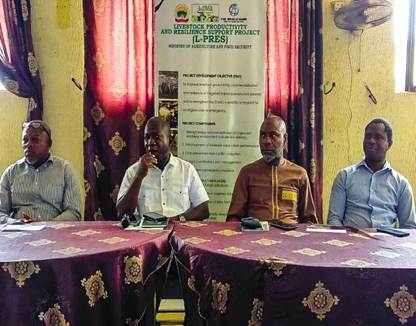
The Ekiti State Livestock Productivity and Resilience Support(L-PRES) Project has mobilized no fewer than 35 inoculators for a statewide vaccination exercise to combat trans-boundary animal diseases and safeguards livestock production.
The Stateholders meeting held in Ado Ekiti, brought together key actors in the livestock sector to strtegise on effective vaccine distribution and administration across the State.
The State Commissioner for Agriculture and Food Security, Mr. Ebenezer Boluwade said that the state government received 80,500 doses of vaccines through the Federal Ministry of Livestock Development.
He listed the vaccines as 50,000 doses for contagious Bovine Pleuropneumonia(CBPP), 30,000 doses for Newcastle Disease and 500 for Foot-and-Mouth Disease(FMD).
He urged livestock farmers to cooperate with inoculators to ensure the success of the exercise.
The Commissioner added that 35 inoculators selected for the exercise comprise 25 from government veterinary services and 10 from private organizations to ensure wide coverage and efficient delivery.
In his remarks, the State Project Coordinator of L-PRES, Mr. Olayinka Adedipe said the initiative aligns with the project’s objective of strengthening animal health systems and enhancing resilience among livestock farmers.
Adedipe said that collaboration between public and private inoculators would ensure effective reach, particularly in rural communities.
Also speaking, the Director of Veterinary Services, Dr. Adedamola Fasoranti, assured farmers of the safety and efficacy of the vaccines.
He stressed that timely vaccination remains one of the most reliable measures to prevent the spread of deadly livestock diseases.
Fasoranti called on cattle rearers and poultry farmers across the state to present their animals for vaccination, noting that the exercise is critical to improving animal health and ensuring food security.
The vaccination campaign is expected to cover the 16 local government areas in Ekiti state, with a view to strengthening the livestock sector and preventing the spread of trans-boundary animal diseases